
Centred variant
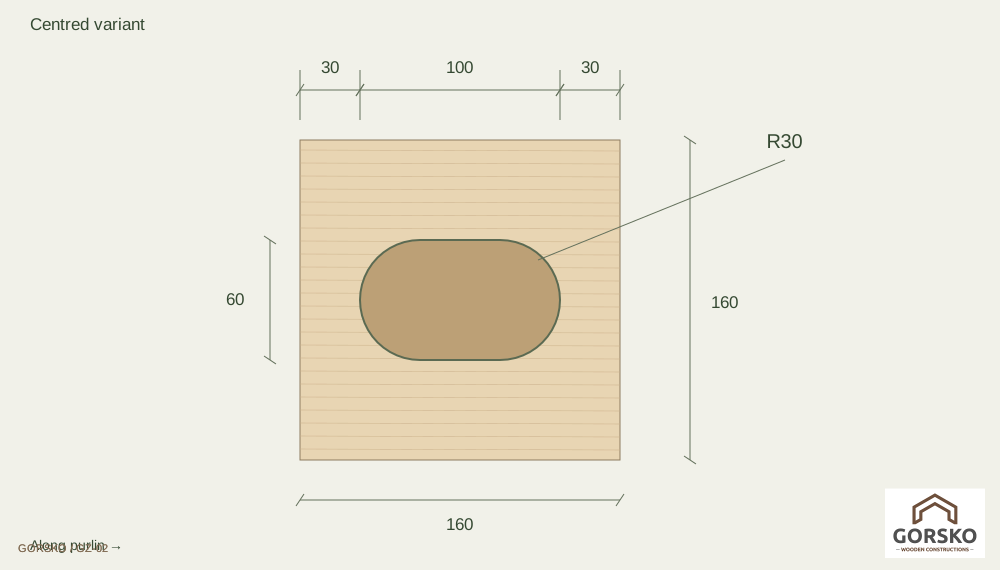
The tenon is centred on the post: 30 + 100 + 30 = 160 mm along the purlin. Across the purlin, each shoulder is 50 mm wide.

Post 160 × 160 mm and purlin 160 × 240 mm. Tenon: 100 mm overall length along the purlin, 60 mm across it, 60 mm engagement and rounded ends R30.
Connection of posts to intermediate or ridge purlins above. The tenon guides assembly and locates the members; post shoulders provide bearing for the vertical support force. [1]
The intended compression path is through the purlin bearing on the shoulders, not through the tenon tip. Avoid water accumulation in the mortise. [1]
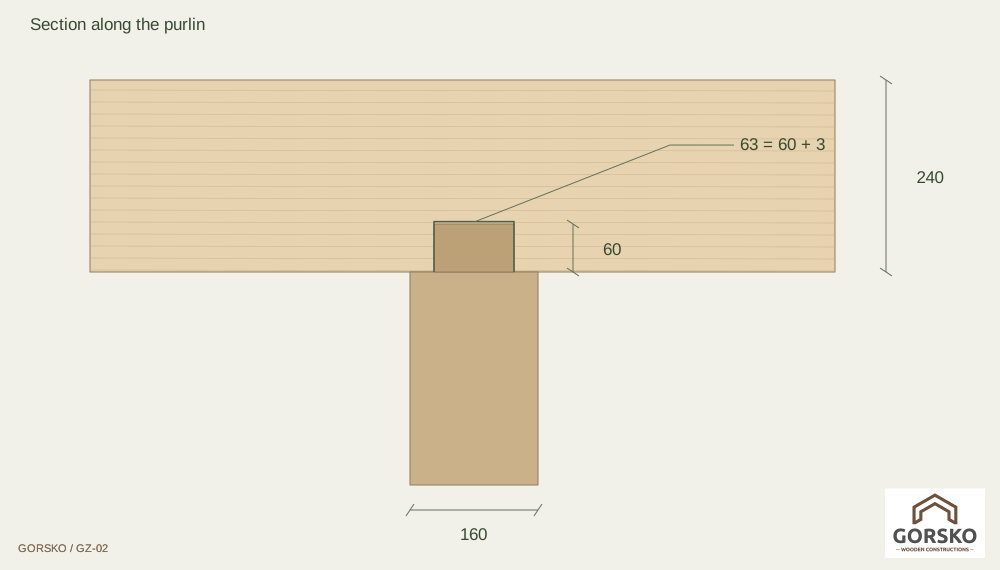
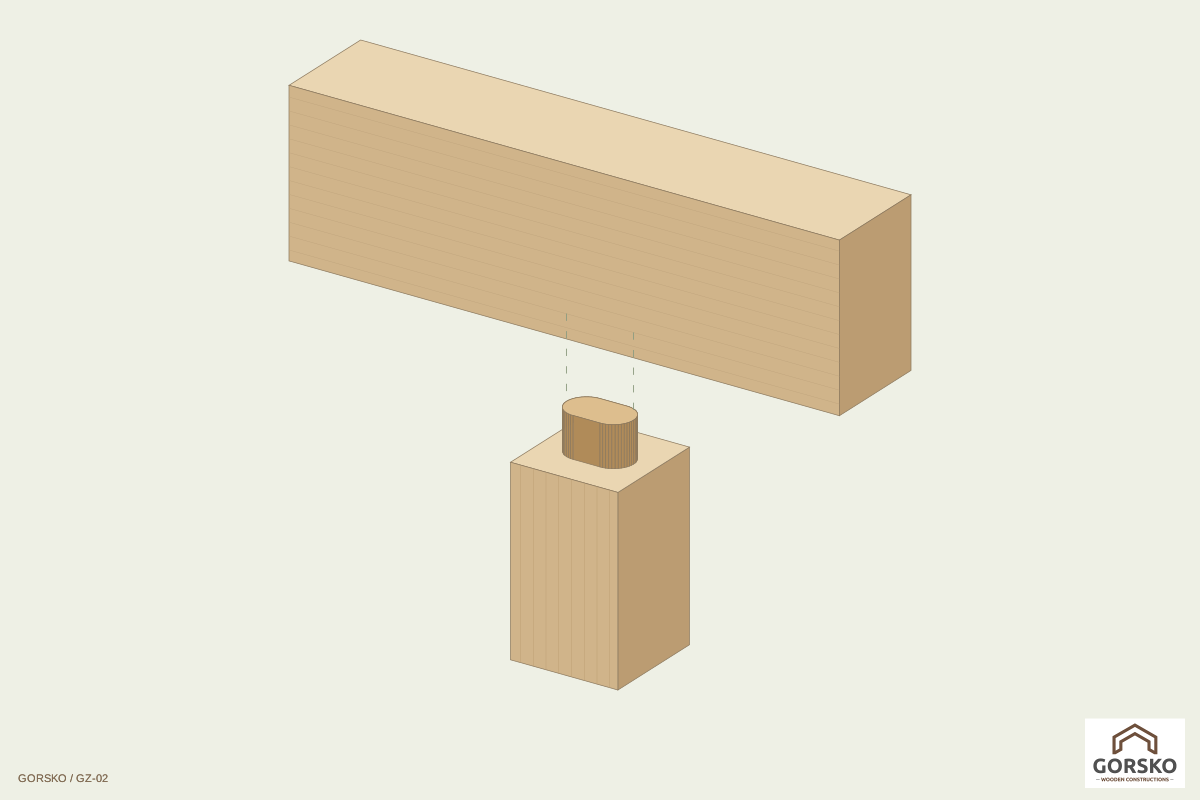
Align the purlin above the tenon and lower it vertically until it bears fully on the shoulders. The tenon must not wedge into the mortise. Install any additional hardware specified for the project.
The tenon is centred on the post: 30 + 100 + 30 = 160 mm along the purlin. Across the purlin, each shoulder is 50 mm wide.
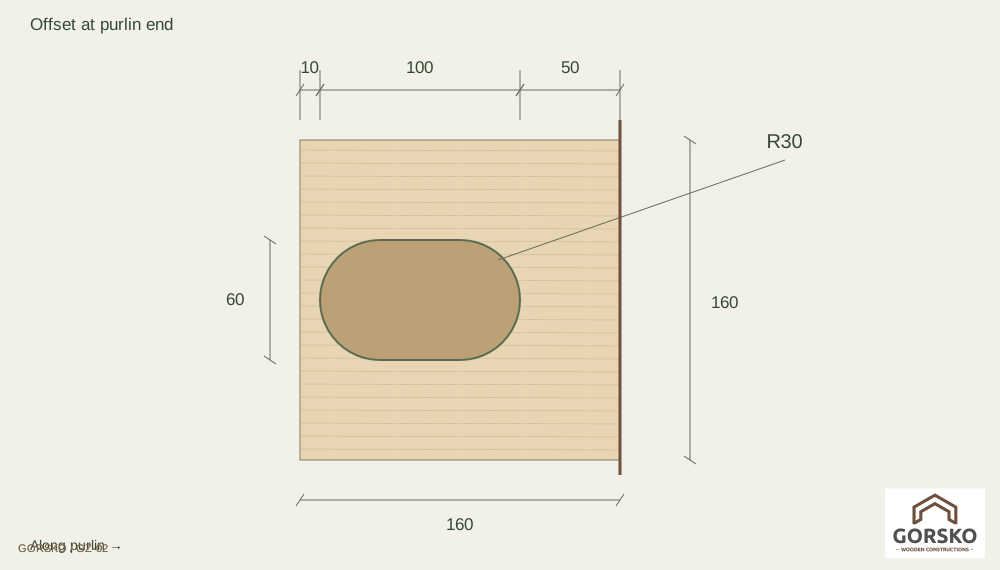
Where the purlin ends flush with the post edge, move the tenon 20 mm towards the purlin interior. From the purlin end: 50 mm setback, 100 mm tenon and 10 mm to the opposite post edge.
GORSKO recommends the 50 mm end setback to retain more timber between the mortise and the purlin end and reduce breakout risk during assembly or service. It is not a universally verified structural edge distance.
Width may be reduced below 60 mm, but GORSKO specifies a minimum 40 mm for the Ø40 cutter. Length may be up to 120 mm. For an obround profile R = width/2: a 40 mm width requires R20, not R30. Length includes both rounded ends.
Dimensions interact. A 120 mm centred tenon gives 20 + 120 + 20 mm; the 50 mm end setback cannot fit a 160 mm post (50 + 120 > 160). Change the tenon length, detail or post section.
Geometric shoulder area for a 100 × 60 mm, R30 tenon is approximately 20,373 mm²: 160² − [60 × (100 − 60) + π × 30²]. This is not the code-effective bearing area or a capacity.
[1] BUBIZA: vertical tenons, pp. 51–59. Based on the older DIN 1052, it explains positioning, bottom clearance and reduced bearing area; it is not a current normative basis.
The 160/160 and 160/240 sections, 100/60/60 tenon, 50 mm recommendation and 40/120 mm machining limits are GORSKO inputs, not dimensions structurally validated by this source.
The PDF uses your selected language. Free download with no catalogue registration.