+386 30 427 414info@gorskoabbund.com
GORSKO / Knowledge for structural engineers, designers, carpenters and installers

Frequently asked questions

CNC machining and timber structures: answers for structural engineers, designers, carpenters and installers

From design to assembly: answers on workshop drawings, structural calculations, timber and CNC machining. Find out how we prepare your timber structure together.

Updated: 3 November 2026

Number of questions: 48

01Enquiries and cooperation

01 What can I order for the preparation and manufacture of a timber structure?

You can order workshop drawings, timber, CNC machining and a component kit ready for assembly. We can also provide fabrication-stage structural calculations.

Read more

We work with structural engineers, designers, carpenters and assembly teams. We can handle the complete preparation or selected parts of your project. Your local structural engineer can review our fabrication-stage calculations and incorporate them into the project documentation. Tell us what you already have and where you need our support.
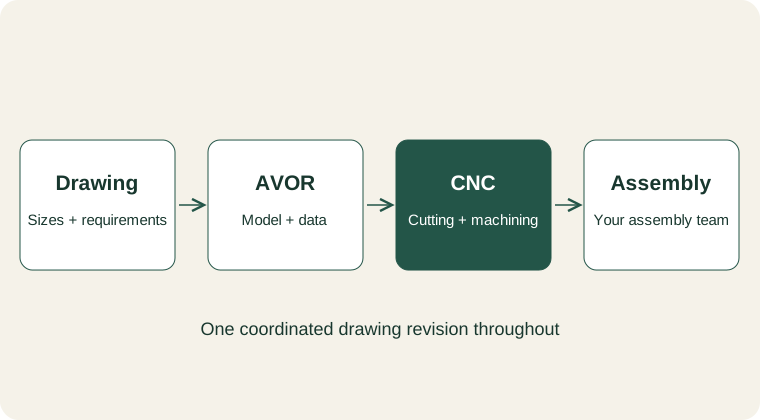
From drawing through production planning and CNC machining to assembly.
From drawing through production planning and CNC machining to assembly. This sketch explains the principle; it is not a fabrication drawing or structural verification.

By agreement, we also provide structural calculations for the agreed scope of the structure. The scope, responsible author, price and design basis are agreed before ordering; for projects abroad, we also coordinate with the local responsible structural designer.
02 Which projects are suitable for outsourced CNC timber machining?

CNC preparation is suitable for roof structures, carports, timber frames, floor beams and structural frames for halls and other buildings.

Read more

We manufacture to individual project requirements, from selected component groups to complete timber structures. Feasibility depends on geometry, material, sections, lengths and machining operations. Send a drawing or dimensioned sketch for an initial assessment.

03 What should I send to obtain a CNC timber machining quotation?

Send current drawings or a 3D model, the delivery location, required date and details of the timber, sections and scope of supply.

Read more

Include timber lists, structural requirements, joint details and visible-surface requirements where available. Attach existing BVN, BVX or other production files with an overview drawing. Identify the revision and whether you need production planning, timber, connectors or transport. Highlight missing information. If you need fabrication-stage structural calculations for your local engineer’s documentation, please mention this in your enquiry.

04 Can I send just a PDF drawing or a sketch?

Yes. A PDF drawing or dimensioned sketch can provide a starting point for reviewing the project and agreeing the required production planning.

Read more

Manufacturing requires clearly defined dimensions, sections, materials and connections. If no production model exists, workshop planning and machine data preparation are agreed as separate services. A sketch without developed joint details is not a directly executable CNC file.

05 What determines the price of a CNC-machined timber structure?

The price is based on the gross material required for production, the selected timber and the agreed scope of supply. Standard CNC operations within the usual scope are included in the CNC joinery price.

Read more

Prices in €/m³ are based on the gross material required to manufacture the order, rather than the net volume of the finished elements. The gross quantity includes necessary machining allowances and production waste during preparation and machining. The chargeable gross quantity is stated in the calculation or quotation referenced in the order confirmation.

There are no per-operation surcharges for standard CNC operations within the usual scope. Following technical review, we prepare an individual quotation for non-standard or exceptionally demanding projects. Any price or scope changes are agreed before order confirmation; additional services, materials and transport are specified separately in the quotation.

06 Is outsourced CNC machining worthwhile for a small order?

It can be, particularly when prefabrication reduces time spent marking out, making joints and adjusting components on site.

Read more

Data preparation, production organisation and transport have a greater influence on small orders. Assess the whole project. Send component quantities, sections, operations and delivery location so feasibility can be reviewed. Acceptance and any minimum quantities are specified in the individual quotation.

07 Can I order timber with machining, or supply my own timber?

You can request timber supply with CNC machining from us. Machining customer-supplied timber requires agreement before delivery.

Read more

For supplied timber, we need to check material, quality documentation, moisture, actual sections, straightness and allowances. Timber must be free of damaging foreign objects. Agree acceptance, storage, unsuitable pieces and material responsibilities. Do not send timber to production before the arrangement is confirmed.

08 What is the lead time, and when does it start?

The delivery period begins when the order is confirmed, the agreed advance payment is received and all necessary data and technical approvals are provided. The shipment date and shipping or pickup details are then coordinated.

Read more

We agree the schedule based on material availability, production preparation, workload and transport. Completion and delivery to site are separate dates. Tell us your preferred assembly date when enquiring; project changes may affect the agreed schedule.

02Delivery, assembly and responsibilities

09 How do we work together on projects in Austria, Germany or Switzerland?

We manufacture in our own workshop in Slovenia and coordinate the planning, supply and delivery with your project.

Read more

Our Austrian offer is also presented on holzbau-tusek.at, particularly for Styria and Carinthia. Send the site location, access details and required date with your enquiry. For Switzerland, we also agree import documentation, customs arrangements and associated costs.

10 What does delivery as a timber structure kit mean?

A kit consists of prepared timber components for assembly on site, together with the agreed drawings.

Read more

Components are cut, machined and marked according to production documentation. “On a pallet” does not mean every structure fits on one standard pallet: long beams require suitable bundles. Connectors, screws, panels, coatings, transport and assembly are included only where listed in the quotation.

11 What must I prepare for delivery and unloading?

Standard transport does not include unloading. The customer provides suitable access, equipment and personnel for safe unloading.

Read more

Buyer provides adequate and safe access, necessary permits, contact person and equipment and personnel for safe unloading. Waiting, re-delivery or special transport will be charged additionally if they are the result of inadequate access or the buyer's unwillingness. Special delivery requirements must be communicated prior to order confirmation.

12 How do I identify components during assembly?

Machined components have position markings corresponding to the assembly drawings.

Read more

A position identifies where a component belongs. Identical pieces may share a position number, so check quantities too. Before installation, compare markings, orientation and current drawings. Request grouping by storey, grid or assembly phase before production and packaging are planned.

13 How accurate are CNC components, and which tolerances should be agreed?

CNC machining is repeatable, but you still have to set tolerances and reference dimensions for each operation.

Read more

Actual timber section, straightness, moisture, machining method and measurement affect the result. One universal tolerance is unsuitable for every component. Agree assembly clearances and contact surfaces for demanding joints. Assess deviations against the approved documents and agreed criteria.

14 Can my team assemble the structure, and are connectors included?

Yes. Prepared components can be assembled by your own assembly team. Connectors and other materials are supplied according to an agreed list.

Read more

Separate timber, connectors, assembly drawings and any assembly support in the quotation. Clarify who supplies anchors, screws, washers and special connectors. The assembly team must follow the design, connector manufacturer instructions, assembly sequence and temporary bracing requirements.

Bonding or resin-grouting load-bearing connectors is not part of our standard offer.

15 When do I approve production, and what happens if I make changes?

Before manufacturing, an agreed revision of drawings and production data must be approved for the ordered scope.

Read more

Check dimensions, sections, materials, visible faces, joints and openings. Approval must identify the revision. Later changes require checking whether timber has already been ordered or machined. New files, rework or replacement components may affect price and delivery.

16 What should I do if I find a discrepancy at delivery or during assembly?

Record the component position, discrepancy, photographs and relevant measurements, and compare them with the approved drawing.

Read more

Report it promptly so the next steps can be agreed. Distinguish transport damage, incorrect components, machining deviations and changed site conditions. Do not modify load-bearing members without approval: new cuts or holes can affect structural performance and the remedy. Agree the repair detail first.

17 Can you provide structural calculations as well as workshop drawings?

Yes. We can provide fabrication-stage structural calculations that your local structural engineer can incorporate into their project documentation.

Read more

We agree the scope with you and your engineer, including loads, materials, sections, connections and other inputs. Your local engineer checks compliance with requirements at the construction location and integrates the calculations into the overall structural design. Workshop drawings and manufacturing data can then follow the same coordinated solution.

By agreement, we also provide structural calculations for the agreed scope of the structure. The scope, responsible author, price and design basis are agreed before ordering; for projects abroad, we also coordinate with the local responsible structural designer.
18 Which material and quality documents do I need?

Required documentation depends on the products, project requirements and rules applicable at the installation location.

Read more

State required strength classes, performance and product-marking documents, and any special requirements in your enquiry. Where required, CE marking concerns the specific product and its intended use; it does not approve the whole structure. Additional certificates or quality marks are included only if valid and confirmed for the relevant scope.

03Planning, AVOR and machine files

19 What does ABBUND mean in timber construction?

Abbund means preparing and machining timber components to their required dimensions for assembling a planned structure.

Read more

It includes cutting, joints, birdsmouth cuts, drilling, other specified machining and marking. It can be performed by hand or by machine. CNC-Abbund uses production data for computer-controlled machining. A rafter with an end cut, bearing notch and prepared holes is a typical example.

20 What is AVOR in timber construction?

AVOR means production or work preparation. It connects project planning with manufacturing and assembly.

Read more

The abbreviation comes from the German Arbeitsvorbereitung. Its scope may include the production model, connection details, timber lists, machine files and workshop and assembly drawings. Good preparation also coordinates materials, markings and assembly sequence. Specify which information you provide and which we prepare.

21 What does CNC mean when machining structural timber?

CNC stands for Computer Numerical Control. In timber construction, the machine cuts and machines components according to a prepared program.

Read more

Depending on its equipment, it can saw, drill, mill, slot and mark components. Data preparation and feasibility checks connect the drawing with the finished component. Accuracy also depends on timber condition, reference dimensions, tools and machine settings.

22 What is a BVN file?

BVN is a Hundegger format for transferring component and machining data to compatible production software. Its extension is .bvn.

Read more

It is used, among other applications, with K2/K3 configurations running EKP. It describes components and supported machining operations. Export software and target machine are relevant to compatibility. Before manufacture, compare BVN data with the drawings and approved order requirements.

23 What is a BVX file?

BVX is a Hundegger production-data format used in compatible environments, including Speed-Cut and CAMBIUM.

Read more

The .bvx extension alone does not identify the content version. BVX 1 and BVX 2 may share the extension but differ in structure and support. Specify export software, interface and version. The data must match the production environment and its machining capabilities.

24 Which files should I send: BVN, BVX, BTL or BTLX?

Send the available production files with an overview drawing. Agree the appropriate export format and version before final data preparation.

Read more

BVN and BVX are Hundegger formats; BTL and BTLX exchange machining data between different software and machine environments. Support depends on the interface. Renaming an extension does not convert a file. A sample export helps check components, orientation, materials and important operations.

25 Are an IFC model and PDF drawings enough for CNC manufacturing?

IFC and PDF are useful starting points, but do not automatically provide complete CNC production data.

Read more

IFC may contain geometry and properties; PDF drawings may provide dimensions and overviews. Detailed machining, tolerances, reference faces or connector data may still be missing. Production planning establishes what can be imported and what needs developing. The final export must match the approved documentation.

26 What is checked before my files enter production?

Before production, we review your data against the order and check the operations on the intended machine.

Read more

Check quantities, positions, materials, finished sections, lengths, orientation, operations and missing or duplicated parts. Complex details need attention to machining depth, tool access and assembly drawing references. A production review does not replace structural verification. Agree exceptions and manual finishing before manufacture.

04Timber, quality and planing

27 What is BSH GL24h, and where is it used?

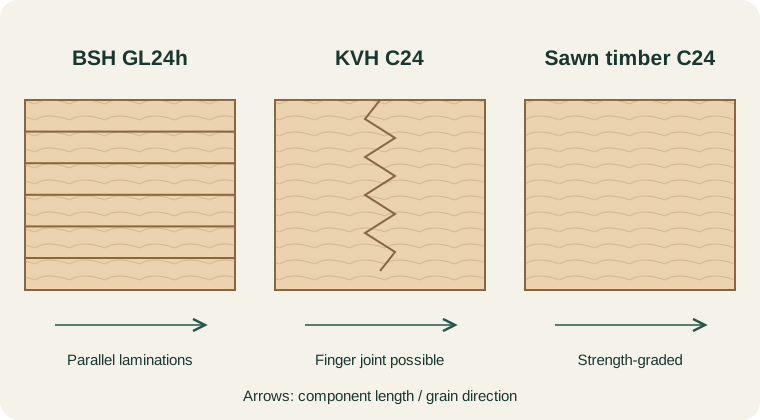
BSH GL24h is structural glued laminated timber, or glulam. Multiple timber laminations run parallel to the component axis and are bonded into a larger section.

Read more

BSH means Brettschichtholz. GL24h is the strength class; h denotes a homogeneous lay-up in terms of lamination strength class. Typical uses include beams, purlins and columns as specified by the structural design. Capacity depends on section, span, loading, stability and joints. It is distinct from cross-laminated timber, CLT.

BSH, KVH and sawn timber construction. Grain runs along the component.
BSH, KVH and sawn timber construction. Grain runs along the component. This sketch explains the principle; it is not a fabrication drawing or structural verification.

28 What is KVH C24?

KVH C24 is structural solid timber of strength class C24, with additional requirements for moisture, dimensional accuracy and surface quality.

Read more

KVH means Konstruktionsvollholz. Common uses include studs, plates and rafters. It may be finger-jointed along its length or non-finger-jointed. Quality-controlled KVH has a specified moisture content of 15 ± 3%. Agree appearance, dimensions and documentation when ordering.

29 What does Schnittholz C24 mean?

Schnittholz C24 is sawn structural timber correctly assigned to strength class C24. An arbitrary sawn beam is not automatically C24.

Read more

C24 describes strength properties, not automatically moisture content, planing or visual quality. Specify those requirements, tolerances and finished dimensions separately. Graded sawn timber suits many structures where the design allows it. Straightness and actual section are particularly important for CNC machining.

30 Are GL24h and C24 equivalent because both contain 24?

No. GL24h applies to glulam, while C24 applies to structural solid timber. The products are not automatically interchangeable.

Read more

In each classification, 24 relates to a characteristic bending strength of 24 N/mm². Other properties and application rules differ. It is not a permitted beam load or directly a design stress. A structural designer must check substitutions between BSH GL24h, KVH C24 and sawn C24 timber.

31 When should I choose glulam, KVH or sawn timber?

Choose according to structural design, dimensions, surface requirements, moisture and use. No single timber product suits every component.

Read more

KVH is common for framing, glulam for larger or specifically designed beams, and graded sawn timber for suitable carpentry structures. Consider available lengths, dimensional stability, costs and moisture protection. Several products can be combined if the design clearly specifies each one.

32 Why does timber moisture matter for machining and assembly?

Timber changes dimensions with moisture. Unsuitable moisture can cause shrinkage, distortion, cracks and altered joint fit after machining.

Read more

Specify moisture and service conditions when ordering. Dry timber still needs protection during transport and on site. Store bundles raised, ventilated and without standing water. CNC machining can produce accurate geometry at manufacture, but cannot prevent later movement caused by changing conditions.

33 Does the strength class guarantee a good visible surface?

No. Strength class and appearance are separate requirements. C24 or GL24h alone does not define all visual characteristics.

Read more

Specify visible faces, acceptable features, edges and any coatings for exposed beams or columns. Si and NSi describe visible and non-visible applications of KVH; glulam surface quality also needs agreement. Planing alone does not guarantee furniture-grade surfaces or completely crack-free timber.

34 What is planing, and how does it change the section?

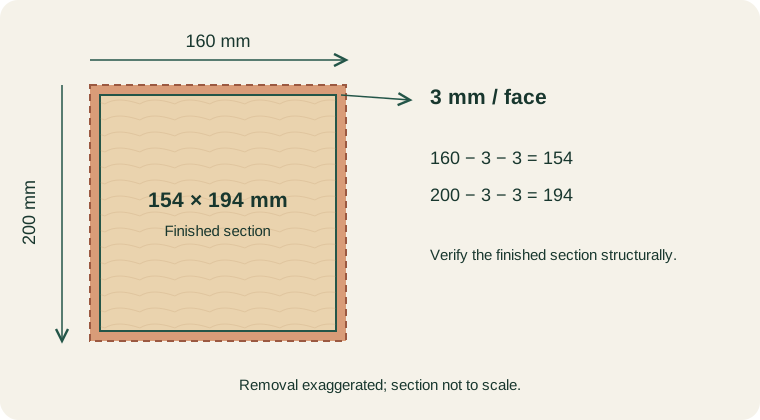
Planing removes timber to level and smooth the surfaces. With an agreed 3 mm removal from each of the four longitudinal faces, width and height each decrease by 6 mm.

Read more

A 160 × 200 mm blank becomes 154 × 194 mm: 160 − 3 − 3 = 154 and 200 − 3 − 3 = 194 mm. This describes the specified removal, not every planed product. For uneven timber, check whether the allowance achieves the required surface.

160 × 200 mm before and 154 × 194 mm after removing 3 mm per face.
160 × 200 mm before and 154 × 194 mm after removing 3 mm per face. This sketch explains the principle; it is not a fabrication drawing or structural verification.

35 Must the smaller section after planing be checked structurally?

Yes. If planing reduces the designed section, the structural designer must verify the finished section and its connections.

Read more

154 × 194 mm cannot automatically be treated as 160 × 200 mm. Section area, bending properties, stability and possibly connector edge distances change. Coordinate the production model and joint details. Use the actual intended finished dimensions; checking removed volume alone is insufficient.

36 How do I order timber if I need 160 × 200 mm after planing?

Specify “finished section after planing: 160 × 200 mm” and agree the rough section or allowance separately.

Read more

With 3 mm removed per face, the theoretical minimum blank is 166 × 206 mm. The actual order size also depends on tolerances, moisture and straightness. Do not automatically deduct another 6 mm from KVH or glulam already supplied at finished size. Clearly distinguish rough, nominal and finished dimensions.

05Timber joints and machining

37 Which timber joints can be CNC-machined?

Depending on machine, tooling and geometry, options include mortise-and-tenon joints, laps, bearing notches, grooves, holes and recesses for connectors.

Read more

Joint selection follows load transfer, assembly sequence and structural design. Tool access, minimum radii and the possibility of inserting the connected components also matter. Send a dimensioned detail with orientation for confirmation. Complex joints may require both machine operations and manual finishing.

38 What is a mortise-and-tenon joint, and what data are needed?

A shaped end, the tenon, fits into a matching opening, the mortise. It locates the components and transfers forces as designed.

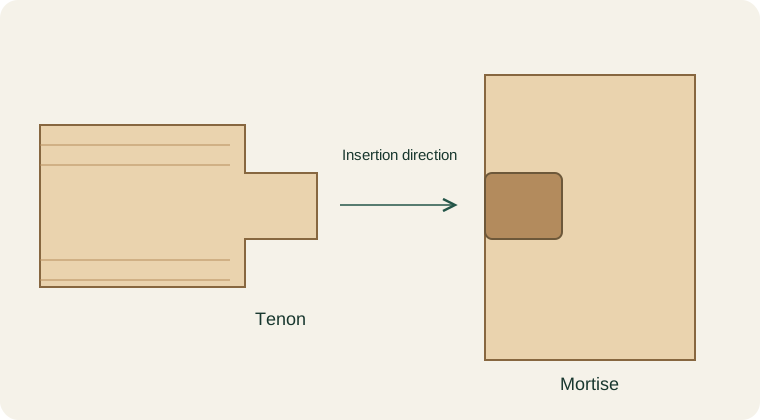
Read more

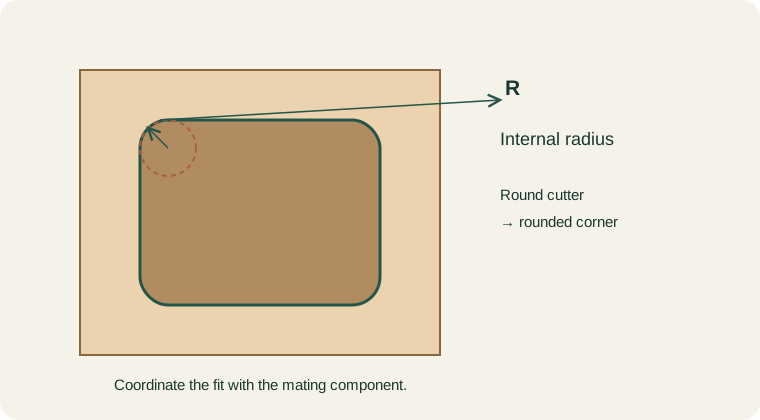
Define tenon and mortise dimensions, depth, offsets and component orientation, plus additional connectors and insertion direction. Milling tools may leave internal radii, so both mating shapes need coordination. Appearance alone does not establish the joint’s load-bearing capacity.

Exploded schematic of a mortise-and-tenon joint.
Exploded schematic of a mortise-and-tenon joint. This sketch explains the principle; it is not a fabrication drawing or structural verification.

39 What is a Gerber joint in a timber beam?

A Gerber joint is a beam splice designed as a hinge within an appropriate structural system. Its location and details follow structural calculations.

Read more

It may use shaped bearing surfaces and designed connectors. It is not a beam extension suitable for any arbitrary position. Check internal forces, remaining sections, bearing areas, connector spacing and assembly conditions. Dimensions from one example are not universal rules for other projects.

40 What is a dovetail joint, and can it replace metal connectors?

A dovetail uses a widening tenon and matching recess. The design determines its use and any additional connectors.

Read more

The shape guides and restrains components in certain directions, but has no universal capacity. Force direction, geometry, remaining section, splitting risk and assembly path matter. Do not omit metal connectors simply because the timber joint fits well. Machining feasibility depends on the detail and tools.

41 Can holes and recesses for connectors be prepared in advance?

Planned holes and recesses can be included if clearly specified and feasible on the selected machine.

Read more

Provide connector type, diameters, depths, positions, reference faces and any manufacturer details. Hole size follows design and connector requirements; it cannot always be taken directly from the screw’s outside diameter. Early coordination helps avoid later drilling or cutting into finished structural members.

42 Why do CNC-routed pockets have rounded internal corners?

A round milling tool normally leaves an internal radius. A sharp corner depends on the process and possible additional finishing.

Read more

The tenon, connector or inserted part must accommodate that geometry. Options include adjusting the mating part, an approved corner relief or agreed finishing. Extra material removal must remain consistent with structural requirements. A very small radius can increase machining time or limit deep-pocket feasibility.

Internal radius of a routed pocket.
Internal radius of a routed pocket. This sketch explains the principle; it is not a fabrication drawing or structural verification.

06CNC machines and capabilities

43 Which machines do you use for timber structures?

We use Hundegger K2, K2i, SpeedCut 480, a Hundegger HMD planing line and a three-axis HyperCut CNC for panels. The ordered ROBOT-Max 1300 is scheduled for commissioning in October 2027.

Read more

We select the most suitable machine and process for your project.

Model data provided; we will confirm the feasibility of individual treatments based on the installed configuration and project.

44 What do the Hundegger K2 and K2i machines do?

We use our Hundegger K2 and K2i to cut and machine components for roofs, timber frames and other load-bearing structures.

Read more

We process sections up to 300 × 450 mm on the K2-450 and up to 300 × 900 mm, with lengths around 20 m, on the K2i-5-900. We choose the machine and machining approach to suit the component and joint. For long members, we also plan handling and delivery to your site.

45 What is the Hundegger SpeedCut 480 suitable for?

Our Hundegger SpeedCut 480 cuts timber components fast, especially when a project has many repeated parts in framing and roof structures.

Read more

It handles sections from 20 × 40 to 240 × 480 mm. We plan operations around the installed equipment and your project requirements. When a detail needs a different approach, we use another suitable machine in our workshop.

46 What does the Hundegger planer do?

We use our Hundegger planer to level and smooth longitudinal faces and produce the agreed edges and finished dimensions.

Read more

We can process sections up to 300 × 400 mm. We coordinate the finished size with the workshop drawing and CNC model so cuts, holes and joints match. Removing an agreed 3 mm from each face reduces width and height by 6 mm each. We check the finished section against the project’s structural requirements.

47 Can you also machine panels for timber structures?

With our 3-axis HyperCut CNC machine, we can process panels up to 4 × 2 m to suit their position and purpose in your timber structure.

Read more

Using your drawings, we coordinate outlines, openings and other machining. Before production, we agree the material, thickness, orientation and relationship to the rest of the structure. You receive panels prepared for the next assembly stage.

48 What is the Hundegger ROBOT-Max 1300?

We have ordered a new Hundegger ROBOT-Max 1300 CNC machining centre. Commissioning at GT GORSKO is planned for October 2027. Until commissioning, the machine is not part of our available production capacity.

Read more

ROBOT-Max 1300 is designed to process wooden beams and cross-laminated timber (CLT), even larger sections. The six-axis robotic unit enables the processing of all six sides in one pass, without turning the element.

Model data provided; we will confirm the feasibility of individual treatments based on the installed configuration and project.

Send your project for review

Send your drawings, location and required date. Together we agree the scope: workshop drawings, fabrication-stage calculations, timber, CNC machining and delivery.

info@gorskoabbund.com
Technical sources